
What is traditional acupuncture?
 Traditional acupuncture is a healthcare system based on ancient principles which go back nearly two thousand years. It has a very positive model of good health and function, and looks at pain and illness as signs that the body is out of balance. The overall aim of acupuncture treatment, then, is to restore the body's equilibrium. What makes this system so uniquely suited to modern life is that physical, emotional and mental are seen as interdependent, and reflect what many people perceive as the connection between the different aspects their lives.
Based on traditional belief, acupuncturists are trained to use subtle diagnostic techniques that have been developed and refined for centuries. The focus is on the individual, not their illness, and all the symptoms are seen in relation to each other. Each patient is unique; two people with the same western diagnosis may well receive different acupuncture treatments.

Traditional acupuncturists believe that the underlying principle of treatment is that illness and pain occur when the body's qi, or vital energy, cannot flow freely. There can be many reasons for this; emotional and physical stress, poor nutrition, infection or injury are among the most common. By inserting ultra-fine sterile needles into specific acupuncture points, a traditional acupuncturist seeks to re-establish the free flow of qi to restore balance and trigger the body's natural healing response.
A growing body of evidence-based clinical research shows that traditional acupuncture safely treats a wide range of common health problems.
What is abdominal acupuncture?
Abdominal acupuncture is a modern microsystem acupuncture technique developed by Dr. Zhi-Yun Bo in China during the late 20th century. Unlike traditional acupuncture which spans the entire body, this method focuses entirely on the abdominal wall to regulate the body's internal organs and meridian systems.
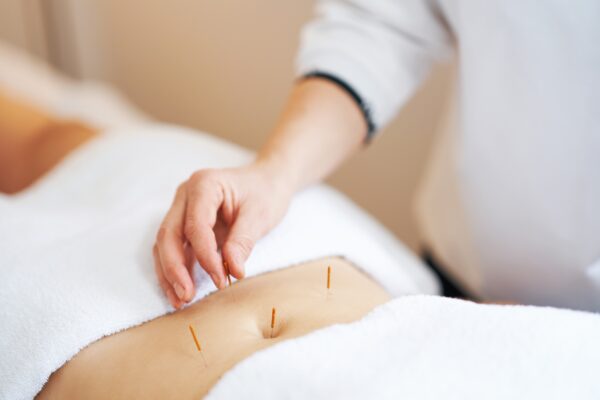
The core principles are built on the understanding that the abdomen acts as a central control center for the body's energy (Qi) and blood. Its foundational concepts include:
- The "Miraculous Turtleshell": The distribution of acupuncture points on the abdomen maps an image of a turtle. The head of the turtle points upward (toward the chest), the tail points toward the pubic bone, and the limbs expand laterally across the abdomen. Stimulating specific areas on this "turtle" corresponds directly to treating the head, torso, or extremities of the patient
- Painless and Safe Application: Because the needles are inserted into the soft tissue of the abdominal wall and rarely reach the muscle layer (unlike traditional acupuncture), the treatment is virtually painless.
Primary Therapeutic Applications
Musculoskeletal and Pain Disorders
- Spine issues: Cervical spondylosis, lumbar disc herniation, and sciatica.
- Joint pain: Osteoarthritis of the knee, frozen shoulder, and tennis elbow.
- Systemic pain: Fibromyalgia and generalized muscle stiffness
Chronic and Internal Organ Disease
- Digestive disorders: Irritable Bowel Syndrome (IBS), chronic gastritis, constipation, and bloating.
- Respiratory conditions: Chronic asthma and bronchitis
Neurological and Cerebrovascular Condition
Abdominal acupuncture is frequently used in stroke rehabilitation and neurological recovery:
- Stroke sequelae: Hemiplegia (one-sided paralysis) and speech difficulties.
- Headaches: Migraines, tension headaches, and dizziness.
- Mood and sleep: Anxiety, depression, and chronic insomnia.
What is Cupping Therapy?
 Cupping therapy is one of Traditional Chinese Medicine's main treatment techniques. It is extremely useful for certain conditions, such as muscular stiffness and tension, which may have resulted from stress or overtraining in exercise. It is also used for unblocking respiratory and sinus disorders such as asthma, chest infection's, colds, sinusitis.
We use traditional glass cups. They are applied to the body by suction. A flame is used to create a vacuum in the cup. It is then quickly placed onto the skin. The vacuum draws up the skin and muscle into the cup, causing the blood to move vigorously upwards with the suction.
In muscular treatments, the cups may be left on for 10 to 15 minutes to invigorate the blood circulation and help detoxify chronic, aching and blocked muscles. In respiratory conditions the cups are placed on and off quickly. This has the effect of relaxing the muscles around the lungs and the neck/head area with the aim of improving the circulation in the chest and head.
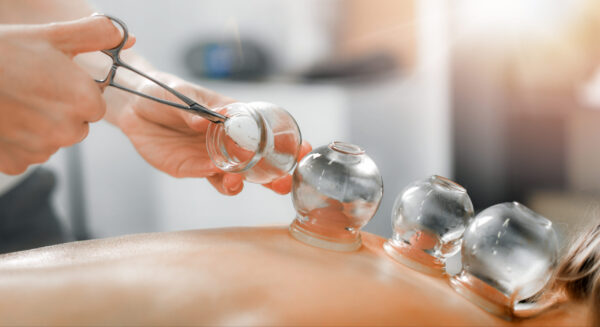
Cupping can leave a temporary mark. The mark that you observe displays the status of the the persons blood. A healthy muscle with good blood circulation does not leave a mark. If the muscle/blood circulation is sluggish it will show some "stagnation" in the form of a red mark. These marks will normally disappear within a week.